
Palomar Amateur Radio Club STEM Experimentation Lab
📡 RTL-SDR Information
The RTL-SDR is probably the most widely known and accessible receive-only SDR. Originally designed as cheap DVB-T television tuner dongles, hobbyists discovered that the raw data stream from the tuner chip could be accessed by a computer. This transformed a $30 TV dongle into a powerful, general-purpose software-defined radio capable of receiving everything from FM broadcast radio and aircraft transponders to amateur radio transmissions. It is an inexpensive software defined radio USB dongle that is ideal for conducting all kinds of RF experiments. It is so popular that support for it is included on almost every SDR program. Drivers for it are available for every Linux distribution, macOS and Windows.
Interestingly, the tuner chips that are used in the RTL-SDR (and many other SDRs) were originally developed for television.
Key Capabilities
The RTL-SDR is ideal for learning about the RF spectrum. Because the processing is done in software, you can visualize 2.5MHz of a band at once using software with a waterfall display, making it easy to spot signals that would be invisible on a traditional radio.
- Broad Spectrum Monitoring: Easily view large chunks of the radio spectrum simultaneously.
- Versatility: Used for general listening, satellite tracking, weather map reception (NOAA satellites), and decoding digital modes like those mentioned in our FT4/FT8 section.
- Cross-Platform: Drivers are available for Linux, macOS, and Windows, making it compatible with almost any SDR software.
The RTLSDR Information webpage in the references lists many applications that can use this SDR. These applications encompass a range of interesting topics and give a good idea of just how versatile this device is.
Information on some useful SDR applications is also available here:
ⓘ SDR Software Applications
There are two primary ways an RTL-SDR outputs signal data: Quadrature Sampling (the standard mode) and Direct Sampling (a mode that bypasses the front-end RF filters for receiving lower frequencies, i.e., 24MHz and below).
- Quadrature Sampling (Standard): Covers the primary range (~24 MHz to 1.7 GHz). This is perfect for VHF/UHF, FM radio, and aircraft communications.
- Direct Sampling (HF): Many modern RTL-SDRs (like the v3/v4) include a "Direct Sampling" mode. This allows the dongle to listen to the HF (Shortwave) bands below 24 MHz, allowing for global communication monitoring without needing an expensive upconverter.
There are two RTL-SDR Blog versions available now, v3 and v4. Version 4 is the latest but being relatively new it isn't as universally supported as version 3 just yet. You may have to install updated drivers for it to function correctly with older software.
The latest version (v4) features improved shielding, better thermal management, more sensitivity and better filtering. The v4 version is also available with either a USB-A or USB-C interface.
- Interface: USB 2.0 (USB-A, v4 also available with USB-C)
- Lowest frequency: 24 MHz (below 24 MHz in direct sampling mode)
- Highest frequency: 1766 MHz
- Max receive bandwidth: 3.2MHz (but really only stable up to 2.56MHz)
- Price: typically in the $30 to $45 range
- Widely copied by many companies (the design is open-source).
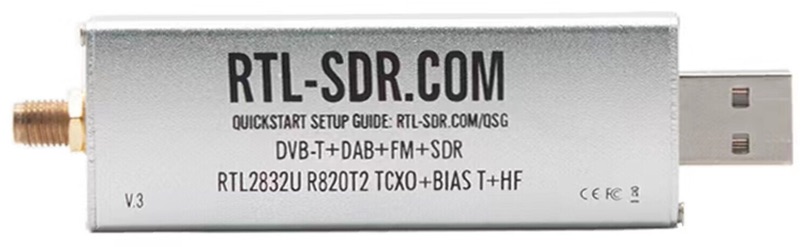
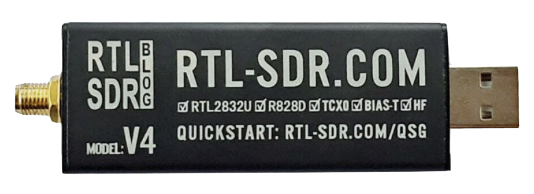
There are a number of different sources for RTL-SDR devices. The ones used in the STEMLab are sourced from RTL-SDR Blog. If you look at alternative RTL-SDRs, be sure and check their specs as these can vary depending on their individual implementation.
A note on RTL-SDR device availability: These devices use commercial TV tuner devices that have been out of production for some time. The RTL-SDR Blog folks managed to stock a large amount of these discontinued tuners but that stock is now running low. This has impacted the production of the new V4 SDRs. RTL-SDR Blog has modified the design and is producing a v4 Lite version. The availability of v3 devices doesn't seem to be a problem at this time.
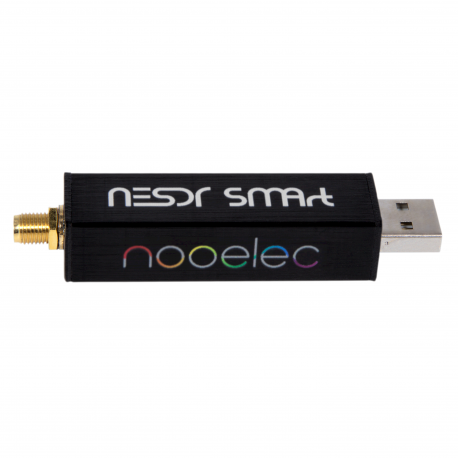
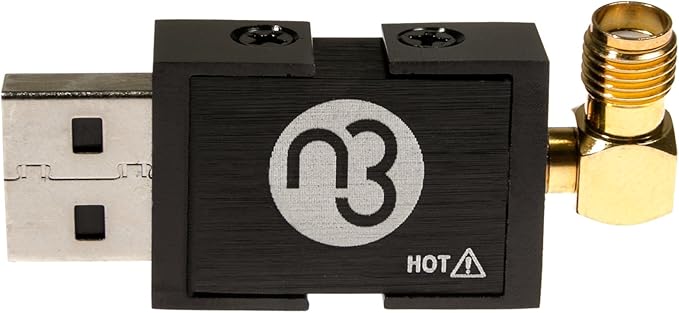
Noolec also produces RTL-SDR type devices that are inexpensive and perform well.
Some Nooelec RTL-SDR Dongles.
Nooelec SmartSDR v5
Nooelec Nano v3
References:
- RTL-SDR Information 🔗 RTL-SDR Overview
- The RTL-SDR Subreddit 🔗 r/RTL-SDR
- Osmocom RTL-SDR Project (Technical Information) 🔗 Osmocom RTL-SDR
Note: PARC does not sell or endorse any products mentioned in these pages.
Information is provided for education and instructional purposes only.